The greater Savannah market is fortunate to have access to many consumer advocates such as local news station reporters and home improvement gurus. They advise that no contracts should be signed until a homeowner has at least two competing written quotes to review.
However, many homeowners have shared with Real Good Roofing,, that collecting multiple quotes is an extremely frustrating experience. Problems include;
Contractors that do not answer their company phone
Contractors that do not return phone calls to offer assistance
Contractors that fail to show-up for their scheduled appointment
When a homeowner is able to get multiple written bids, the process remains complicated. Roof bids on the same home often use different terms and the prices vary. This may be due to;
the Contractor has miss-measured the roof
the Contractor is using sub-grade materials
the Contractor is not using all of the system pieces your project must have
Real Good Roofing, understands your frustration with our industry. Our certified, knowledgeable estimators are the best in the city, and our courteous, skilled installers complete hundreds of jobs every year! We know your time is valuable and we promise to arrive when we say we will, and to be respectful of your property at all times.
Many roofers believe that homeowners are ignorant and cheap. They believe that the cheapest price gets the job. The Real Good Roofing,price list is pre-set by system component. Your pricing is determined by the system pieces that your home needs and not by how much we think we can charge you. All of our quotes qualify for an Extended Warranty.
Please remember that there is often a huge difference in PRICE and COST.
Low PRICE often leads to high COSTS in re-work and damage.
The only thing worse than buying a new roof, is paying for it twice
Membership taking roofer to new heights Joining a `necessity’
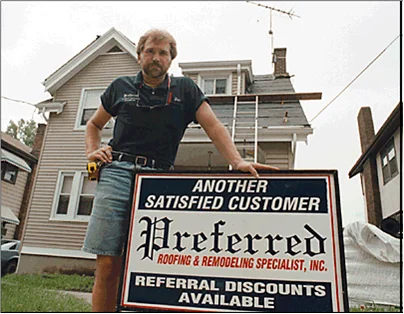
According to Dale Shoemaker, the planned transformation of Preferred Roofing & Remodeling into a leader in its field would have one important pre-requisite: The company must become a member of the Greater Cincinnati Chamber of Commerce. Since signing on last fall, Shoemaker has relied on the Chamber for all kinds of assistance, including networking, cost-savings on business services, and even guidance in setting up a presence on the Internet. “To me, joining wasn’t an option or a luxury,” he said. “It was necessary to achieve our goals. It would give us instant credibility.”
When Dale Shoemaker sat down with his father-in-law, Rick Feltner, to figure out what it would take to move Preferred Roofing & Remodeling Specialists Inc. to the top of its field in Greater Cincinnati, Shoemaker was adamant about one thing. “I said we needed to do this the right way,” said Shoemaker, who left a position as sales manager for C:Tel Cellular two years ago to join Feltner’s family business in the Eastgate area.”To be a city-wide roofer, we needed a Yellow Page presence that we didn’t have; that was obvious. But we also needed to join the Chamber. To me, joining wasn’t an option or a luxury. It was necessary to achieve our goals. It would give us instant credibility.”
Chamber offers answers
For Shoemaker, who knew a little about the Chamber because of C:Tel’s affiliation with Chamber partner Cellular One, it was the answer to the many of the questions that can vex a growing company: How will we raise our profile throughout the city? How will we afford the insurance we need? How will we meet the unexpected challenges lying just around the corner? Shoemaker said the benefits started immediately. “We instantly realized big cellular savings by going on the Chamber’s program,” he said. “The bill for Rick’s phone dropped from $180 a month to under $100 the first month. I remember Rick thought there was something wrong with the bill.”
The company now has four cellular business lines, and just added four more lines on the Chamber plan’s “member-employee” feature, which extends savings to the personal lines of Chamber-member employees. “Like any business, we must communicate with each other efficiently, and this helps us do that,” said Shoemaker, who is also switching Preferred Roofing’s long-distance phone service to the Chamber’s discount plan through Cincinnati Bell Long Distance.
Taking the business on-line
But Shoemaker wants to do more than save money. He’s looking to do something he says no other area roofer is doing: Market through the Internet. And after attending the free Internet workshop at the Chamber June 26, he intends to use the Chamber as his guide.
“Four of our major roofing manufacturers have interactive web sites now, and we need to be connected,” he said. “We’re signing up with the Fuse access service through the Chamber, and we plan to set up our own web site. We intend to fill a niche that no one else in our business is filling.”
But while Shoemaker relishes the cost-saving programs and technological opportunities his Chamber membership offers, he really enjoys the “people” aspect what he calls the “fun side.” “You can go to the breakfasts, the workshops, the after-hours events, and really have a good time,” he said. “For instance, we attended a Business After Hours a while back during our slow season, and someone we met there called us back later and gave us some good winter business business we wouldn’t have gotten otherwise.”
Ask and ye shall receive
Shoemaker has also learned he can just pick up the phone, call the Chamber and get what he needs. “Just tell them you’re thinking about getting involved in the Chamber, and they’ll take it from there hook you up with people who can help you. I think a lot of people don’t know about everything the Chamber does. “Membership is not just a plaque on the wall. There’s so much that we haven’t had time to do yet,” he said. “But you have to take the first step.”
As Preferred Roofing continues its quest to be the leading roofer in the area, Shoemaker is going to make sure the Chamber is with him every step of the way.”You’d be foolish not to look at Chamber membership as a great opportunity,” he said. “You couldn’t kick us out of this organization.”
Membership: ‘Much more than a plaque on the wall’
What does the Chamber mean to a small but growing business such as Preferred Roofing & Remodeling Specialists? According to vice president Dale Shoemaker, it means many things:
Stature in the business community
“Joining was necessary to achieve our goals. It would give us instant credibility.”
Savings
“We instantly realized big cellular savings by going on the Chamber’s program.”
Bottom-line value
“It’s a great opportunity. You couldn’t kick us out of this organization.”
Q. Why does my insurance company say that my roof is too old and that I must replace it? It still looks okay…
Insurance carriers have detailed data on how long roofs are expected to last. Somewhere in every homeowner’s file, your carrier has the data on how many roof permits have been pulled (and when) on your property. Where current homeowners of older Tampa Bay area homes can run afoul of their insurer, is if sometime in the past, a previous owner of the property changed the roof but did not inform the county via a Notice of Commencement and a Permit. The couple hundred bucks they got away with, is now all hanging around your neck.
Insurance companies seek out four points of a roof wind mitigation report. When a roof meets these points, there are mandatory premium discounts that the home will receive, from that date forward. Every subsequent homeowner will benefit greatly, from having as many of these points met and documented.
1st. is the shape of the roof, which is important in relation to how much pressure blowing wind must exert before damage will occur. A hip roof is always preferable for standing up to wind and for insurance rates, but gable roofs still protect you and your family. Flat roofs tend to be harder to insure since Florida has a severe rainy season, but when properly installed, they provide years of protection.
2nd. will be the re-nailing of the wood decking while all of the old roofing material is off. Using an 8d common ring shanked nail, driven into every truss – rafter at 6” intervals, helps to prevent wind pressure from damaging a roof. During the re-roofing process, many counties’ will come by to perform a ‘mid-point’ inspection and check to see if this part of the code has been fulfilled. Depending on the type of wood used to create the wooden roof substrate, your roofer may tell you that your home does not need this step. Because every inspector can interpret the FL code differently, it is our installation policy that every wood roof gets re-nailed to meet FBC 611.7.1, regardless as to if we think it might be passed with-out adding this application.
3rd. has to do with the roof’s pitch. Pitch is measured from the eave to the roof’s ridge. Many Tampa roofs are considered to be 4:12 meaning the roof rises on an angled plane, 4” for every 12” of length. Roof pitches below 4:12 require extra material per FL 1507.2.2. Homeowners can choose to use self-sealing underlayment across the wood roof before any shingles are installed. These self-sealing membranes are hardy, waterproof and seal around all penetrations, thus helping to prevent wind driven rain from finding its way under the roof and into a home. It is our roof installation policy that all roofs between 2:12 and 4:12 be protected by having this critical roof component installed.
4th. has to do with the shingle that is being installed. Shingles can be valued in a Good, Better, Best scenario. Good shingles can also be referred to as Code Minimum, meaning they meet the bare minimum tolerances that the Florida code allows. Characteristics include having three tabs, only offering a 25 year warranty and barely being able to withstand winds of no more than 65 MPH. Better shingles, also called architectural, can last for 30 years and survive winds of 110 MPH. The best shingles feature special bonding agents, superior design changes, 130 MPH wind resistance, and anti-algae coverage.
Q. Why does my insurance company say that my roof is too old and that I must replace it? It still looks okay…
Standard shingles are expected to last about 15 years in Florida conditions according to the data your insurance company operates by.
Architectural shingles are expected to last 20 years or more, when installed properly by the roofer.
This does not mean that they cannot last for a longer or a shorter time. What it does mean is that many insurance companies require that Good shingle roofs be less than 15 years in age and that Better and Best architectural shingle roofs, be less than 20 years in age, in order for a new policy or for continued coverage, to be issued.
Some insurers will even send out letters 12 months before the respective 15 and 20 year annual roof age dates, requiring a roof replacement as a condition of coverage.
This may sound unfair at first, but imagine if you were responsible for 250,000 roofs or more, across a large area. Your data proves that normal wear and tear generally causes the need for a full replacement by a certain age. It then makes sense to require maintenance based on that data to prevent predictable large damages.
This also helps to keep all policyholders rates lower when the carrier is not writing off hundreds of roofs each year.
Homeowners who receive a mandatory re-roof notice do have options.
Hiring a licensed roof or home inspector might be the answer. Inspectors with the proper roofing credentials, can be called out to prepare a report citing their observations about what they discover. They try to assess a roof’s age via permitting data and also by pliability, brittleness, and granule loss, among other key indicators.
We offer a 25 point inspection that includes digital video taken from the roof a well as digital pictures.
This report has a value of $125.00, but that charge can often be waived depending on the circumstances.
WHAT ARE THE PROS AND CONS OF PBR PANELS ON METAL BUILDINGS?
What is a PBR Panel? PBR stands for “Purlin Bearing Rib” panels.
On a prefabricated metal building, steel components called “purlins” attach across the rafters.
The PBR panels fasten to the purlins to create the roof of the structure.
PBR panels connect to the steel “girts” that run across the steel columns.
Steel panels create the “skin” or exterior of most brand steel buildings.
Panels cover both the roof and the walls of basic pre-engineered steel buildings.
PBR panels are formed with deep trapezoid-shaped “ribs.” Smaller ribs fashioned between the deeper ribs provide added strength without adding weight to the panels.
PBR steel panels are very economical. The ribs increase visual appeal.
High-quality rust-resistant screws with weather-resistant washers connect PBR steel panels.
PBR panels contain two layers of protective coating;
The first layer is corrosive-resistant Galvalume®.
The second layer is a baked-on color, available in a rainbow of vibrant colors, with a 30-warranty.
Two basic types of steel panels dominate the metal building market today:
PBR-panels
R-panels
What Makes PBR Steel Panels the Better Choice?
PBR panels are 26-gauge steel, while R-panels are formed with thinner 29-gauge steel.
The 1-1/4” rib height of a ribbed steel siding greatly increases strength over the shallow 5/8”-deep rib of an R-panel.
PBR steel panels overlap more between panels than R-panels. Greater overlap equals a stronger joining; shorter overlap produces a much weaker connection.
A person walking on the roof will not crush the stronger PBR Weaker R-panels may crimp or buckle under a worker’s weight.
The deeper metal-to-metal contact of PBR panels increases waterproofing. The weaker connection of R-panels increases leak chances.
Energy-saving cool-coated panels, covered with a special light-reflective coating, save on utilities in warmer climates.
Coastal areas, where salt spray permeates the air, require panels coated with a special Kynar® corrosive-resistant coating.
Brown water mark stains on kitchen or bathroom ceilings
We have all been in a home and noticed those ugly brown ceiling stains, but most of us have no clue what they are caused by. Many homeowners call a roofer and pay thousands for a new shingles, when a couple hundred bucks could have fixed the issue!
Mystery roof leaks are often caused by what roofers call ‘pipe boots’.
Pipe Boots are the coverings that go over the vent pipes that stick out of your roof. And many of them have been allowing rain to leak into homes. Most of these type of leaks are not detected for months…or even years. At Real Good Roofing we pay careful attention to their condition, and have found that replacing them can buy you more time before you buy a new roof!
If your pipe boot covering fails, rain will leak into your home and travel along the vent pipe. This is why you might see water stains in the ceiling or walls in your kitchen or bathroom areas, which is where the vent pipe begins its journey up toward your roof. Sometimes leaks go undetected for years, building up behind ceilings or walls and soaking insulation, promoting the growth of mold and mildew which can create huge and dangerous problems for your family.
Every home has plumbing vent pipes, which allow air to enter the waste line of your home’s plumbing system. This air provides needed pressure to push the waste water into the sewer system. These vent pipes always run up from a kitchen, bathroom and laundry room and out through your roof. The more sinks and toilets, the more boots your home will have.
The system is designed so that rain can enter into the pipe and be carried away safely from your home. The problems arise when the coverings around these pipes, called boots or vent pipe covers, crack, break, peel up or get shifted with the natural movements that occur on your roof, from expansion and contraction.
Richmond Hill Homeowner Says Real Good Roofing is the Best
Record breaking rain-falls were followed by a windy nights, and roofs everywhere are showing the effects. Jim and Sandy Krajceck of Bryan County knew that this was the year they would need a roof, so they called on Real Good Roofing.
“I had read about Real Good Roofing in the paper, and thought boy, if I ever need a roof, I’m calling them!” said Jim Krajceck. “So last month, we noticed a stain on one of our ceilings and I thought, I better call. I phoned at night, expecting to get a machine, and was pleasantly surprised when Missy answered the phone. We set up an appointment, and danged if they didn’t get here a little before scheduled! They went into our attic with a thermal camera and quickly found our leak. He then went up on the roof and took pictures and measured our roof. Then he came down and explained everything to me, and gave me a very detailed estimate. I asked a lot of questions, and he answered all of them.”
Jim and Sandy were so impressed they hired Real Good Roofing to do the work and were scheduled for a new dimensional shingle roof installation. Krajceck went on to say that the Real Good Roofing crew were extremely neat and clean as they took off two roofs, worked on the chimney, cleaned the old gutters and added new leaf guards.
“I had checked them out on Angie’s List and the BBB and learned they had no complaints and the highest ratings,” Krajceck stated. “About two weeks after the roof was put on, we learned why so many of their customers spoke so highly of them. My wife discovered water all over our floor. Naturally, we called Dale back out, thinking it had to be the roof, boy were we wrong. Justin Shoemaker arrived with-in two hours of our call, and climbed up onto the roof in a driving rain to check it, then crawled all through our attic to be sure it was dry. The roof was fine; his pictures proved we had no roof leaks. But he didn’t want to leave us with the wet kitchen floor, so he kept hunting until he finally helped us find that the refrigerator had a broken line and was leaking. You don’t find that kind of old fashioned dedication to customer service too much anymore.”
Real Good Roofing has roots that began in 1995, when Rick Feltner, operated a small family business from his garage. Over 21 years later and Ricky’s daughter Missy answers your calls and Ricky’s grandson Justin runs the day-to-day operations.
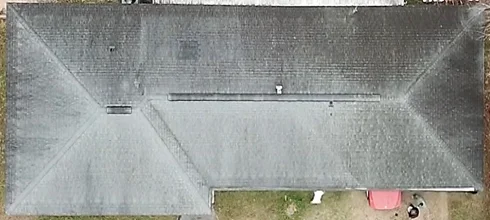
Real Good Roofing estimates are free of charge, and include an attic check, as well as color digital pictures of what they find. Today’s best technology, such as thermal cameras are utilized in order to pinpoint hidden leaks and decay. Satellite measuring from iRoofing, and DRONE flyovers ensure to the inch measurements for to the penny pricing.
“I don’t think I’ll ever need a new roof, because I’m 68 and this is a lifetime dimensional shingle,” said Krajceck. “But I have recommended Real Good Roofing to everyone I can, because I couldn’t be happier with the work they performed. They were prompt, very clean, very professional, and super precise. In fact, they have done new roofs for five of my neighbors, based off my referring them!”
For a free quote on tile, flat, metal and shingle roofing, call their offices at 420-GOOD (912-420-4663). Find them on Facebook to see pictures of different projects they have completed.
We have heard people explain black roof streaks as
being caused by everything from
chimney smoke settling
acorns cracking on the surface
tree sap
aging shingles due to granule loss
However, the stains and streaks are a form of algae. Staining has been showing up on area roofs since 1995. Cutting back on tree canopy, or forgoing the use of a fireplace will not correct the problem.
The spores are air-borne, and are driven through-out the neighborhood by the wind, settling when and where they will. To grow into a visible colony, they require the correct amount of three key elements.
Humidity (welcome to our summers!)
Limestone (a key shingle ingredient)
Sunlight ( Welcome to Georgia)
So if this is true, why do neighbors have nothing and my roof looks like swamp thing walked all over it?
Sunlight is probably the culprit
Q. So if this is true, why do neighbors have nothing and my roof looks like swamp thing walked all over it?
A. Sunlight is probably the culprit
to much sun and the colony burns up
to little and it never gets started
Which is why even on the same home, only certain roof faces are affected, while others are clean.
Metal oxidation also helps as a colony preventative. Look directly under the chimney, soil pipe flanges, and other metal roof protrusions, and you will likely find that the roof is free of discoloration.
To properly element roof staining, you should always consider ZINC or COPPER stripping be applied after the roof is cleaned, to help prevent a new infestation.
When replacing a roof, use shingles that are marked as AR (algae resistant) .
Beware!
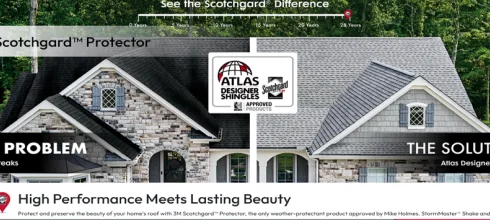
Some shingle makers use an AR label to mean ALGAE RELIEF (meaning if the shingles get stained, the maker will clean the roof). ATLAS shingles are ALGAE RESISTANT and ATLAS will pay for them if they ever stain!
We like ATLAS shingles with Scotchgard protection because their warranty is superior!
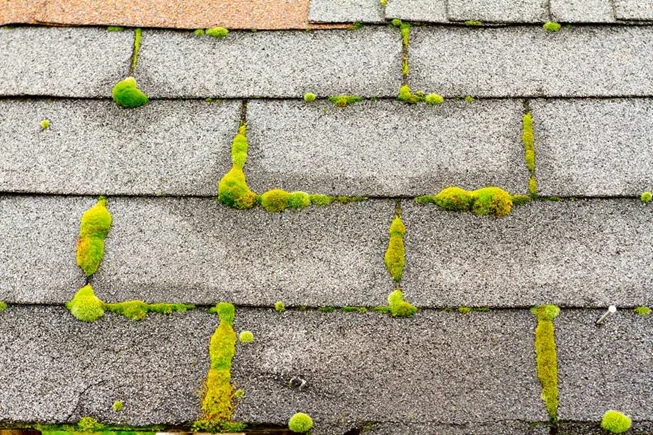
Roof moss is different from roof algae and is more dangerous because it will grow underneath the roof shingle and act like a sponge, soaking up water after it rains.
Eventually the moss will cause roof leaks if not treated.
Roof moss accumulates on the North side of the home or where shade is most prevalent.
Only a professional roofer should attempt to remove roof moss, as it almost always requires some shingles to also be replaced.
Roof moss, once attached to a shingle roof, feeds on the dead organic matter used in the manufacturing process of the shingle. As the fungus breaks down the asphalt shingle, the ceramic granules protecting the surface of the shingle are loosened and begin to fall off. This causes the roof to deteriorate prematurely and diminishes the roof’s abilities to reflect heat rays.
If left untreated, roof moss may;
reduce the life of your roof
diminish your home’s curb appeal
increase your homes cooling expenses
The initial removal of roof moss is always more difficult then its prevention;
A standard practice should be to clean your roof and then apply a preventative product such as zinc bars, Z-stop, or copper strips, to keep the stains from returning.
With the introduction of AR SHINGLES, designed to fight discoloration, and companies accepting work to clean shingles, roof cleaning and prevention has never been easier. But a word of caution; there is a right and a wrong way to fight the problem.
NEVER:
Force water up and under the shingle
Seal and/or Scrub the roof with a hard bristle brush
Dump pure bleach over the shingles
Many people spend time and money cleaning their homes every year
only to ignore one of the most visible and important aspects of the home; the roof.
Adding a roof algae/moss prevention program to your annual spring cleaning chores will result in a beautiful home that looks fresh and clean!
“You’re not inviting contractors to give an estimate, you’re inviting them to distinguish themselves by excelling at an interview,” So instructs James Hayes from Real Good Roofing. “When you shop for a roofing contractor you’re more than just a potential customer, you’re acting in the capacity of Domestic Human Resources Manager. You’re hiring, and if you know how to conduct the interviews, you’ll make the best choice”.
In a typical search, too much time is spent discussing the job and too little time is spent discussing the people who’s going to do the job. A trustworthy maxim in the roofing industry is, “Choose your roofer first, choose your roofing last.”
In other words, don’t allow yourself to get so excited about colors and styles that you miss the roofing contractor’s character. In all other areas of your life you’re constantly reading people. Put that experience to work for you now as you “read” prospective contractors. Does he look you in the eye? Does he listen? Does he take notes when you speak? A no could mean you need to dig a bit deeper. Two no’s could mean he’s more concerned about selling something — anything—than he is about doing a great roofing job for you. Three no’s could mean you should send him packing without your autograph in his briefcase.
If a contractor mentions more than once how honest he is, it’s a safe bet that he isn’t…I’m not sure why this rule works, but it does. Trust me, I’m honest. And no, I will not repeat it!
Ask open ended questions that can’t be answered “yes” or “no.” For example, since most roofing contractors would like for you to believe that every job they’ve ever done has gone perfectly, you might ask, “What are some mistakes you’ve made on past jobs, and what did you do to correct them?” Open-ended questions should flush out some interesting stories. If no useful information is forthcoming, keep another inviolable rule in mind: The last roofer you should consider is the one who’s never had a leak!
Your roofing contractor may want to control the interview, and he may use his factory-supplied material literature to try to lead you through a long and laborious dog and pony show. The majority o f roof complaints have to do with workmanship rather than material, so refuse to be led down his material-oriented road. As long as you’re courteous and attentive, it’s perfectly acceptable for you to steer the interview away from bells and whistles and back to the issues of his competence and his desire to serve you.
Ask for his ‘resume’. See if he has the qualifications for the position, education (there are schools, classes and certifications), experience, (Angie’s List and the BBB have his record), and who his people consist of, (employees, subbers, undocumented work force). What if your contractor seems to resent your interrogation? Better to expose his thin skin now rather than discover — after he has the deposit — that he’s nearly impossible to work with.
Always remember that you’re not inviting contractors to come out and give you an estimate. You’re inviting them to into your home and offering them the opportunity to distinguish themselves from their competition, and so earn a job!
To interview Real Good Roofing about your next home improvement, simply call Missy at 420-GOOD (912-420-4663) or visit them on social media.
A cricket or saddle shall be installed on the ridge side of any chimney or penetration greater than 30 inches wide as measured perpendicular to the slope. Cricket or saddle coverings shall be sheet metal or of the same material as the roof covering.
Chimney Cricket – Chimney Flashing
Pro-Tip: All crickets will need chimney flashing, but not all chimney flashing will need a cricket
Qty
Materials
Cost
1
2” x 4” x 8’
10
2
plywood sheets
80
1
box of peel and stick
50
2
tubes of mortar caulk
15
1
grinder multi blade
10
1
roll of metal 24” x 50’
75
1
Pack of 5” x 7” step flashing
50
1
Crew Labor
150
1
Secured Markup
150
1
Chimney flashing labor
200
1
Secured Markup
200
Crew creates the frame and the plywood wedges to fit chimney saddle
Crew uses grinder to RAGGLE cut chimney brick courses
“You’re not inviting contractors to give an estimate, you’re inviting them to distinguish themselves by excelling at an interview,” so says Justin Shoemaker from Real Good Roofing.
When you’re shopping for a new shingle roof, you’re more than just a potential customer, you’re acting in the capacity of “Domestic Human Resources Manager.” You’re hiring, and knowing how to conduct an interview, helps you to save your money.
In a typical search, too much time is spent discussing the job and too little time is spent discussing the people who’s going to do the job. A trustworthy maxim in the roofing industry is, “Choose your roofer first, choose your roofing last.”
Essentially, Shoemaker advises against getting overwhelmed by colors and styles to the extent that you overlook the character of the roofing contractor. Draw parallels to your everyday interactions where you assess people, applying that experience to evaluating potential contractors.
Does he look you in the eye?
Does he listen?
Does he take notes when you speak?
A no could mean you need to dig a bit deeper.
Two no’s could mean he’s more concerned about selling something (anything!) than he is about doing a great roofing job for you.
Three no’s probably means you should send him packing without your autograph in his briefcase.
If a contractor mentions more than once how honest he is, it’s a safe bet that he isn’t. I’m not sure why this rule works, but it does. Trust me, I’m honest, and No! I am not going to repeat myself!
The best questions to ask are open-ended. Ask questions that can’t be answered by a “yes” or “no.” For example, since most roofing contractors would like for you to believe that every job they’ve ever done has gone perfectly, you might ask, “What are some mistakes you’ve made on past jobs, and what did you do to correct them?” Open-ended questions often flush out interesting stories.
If nothing useful is forthcoming, keep another inviolable rule in mind: The last roofer you should consider is the one who’s never had a leak.
Your roofing contractor may want to control the interview by using manufacturer supplied literature to lead you through a long dog and pony show. According to the BBB, a majority of complaints have to do with workmanship – not material. So keep them focused on their ability. Note how you are treated before any money for services is exchanged. Are they respectful of your time, arriving when promised and are they easy to communicate with. Many complaints by homeowners start off the same way, “I could never reach my roofer” If a contractor seems sketchy without having any of your hard earned savings, why would that improve after you pay for the a new roof?
Shoemaker suggests asking for a “resume’ to see if they are qualified for the job!
Education, (there are schools, classes and certifications),
Experience, (Angie’s List and the BBB have his record),
Employees, (who does the actual roofing).
What if your contractor seems to resent your interrogation? Better to expose a thin skin now rather than discover, after you paid a deposit, that you are not comfortable with them around your family.
Always remember that you’re not inviting contractors to come out and give you an estimate. You’re inviting them not your home and offering them the opportunity to distinguish themselves from the competition, and so earn your job!
To interview Real Good Roofing – contact BRODY anytime. They answer the phones, even at nights, on the weekends, or over a holiday. They know Mother Nature does not keep banker hours!